
The House of Breathing Stones – By Noopur Joshi
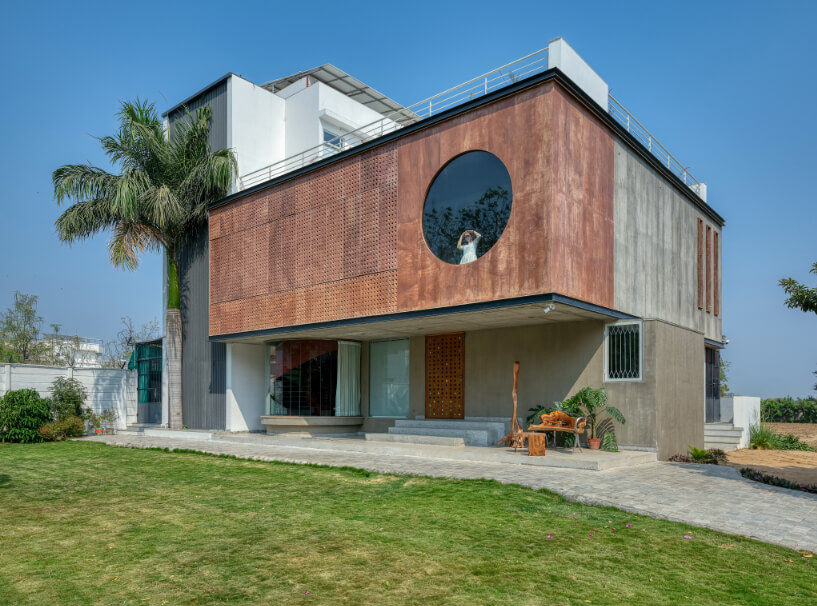 Set amidst the agricultural fields of Vadodara, Gujarat, the House of Breathing Stones stands as a quiet yet radical statement. Designed by young architects Milan Patel, Dutt Patel, Parth Sheth, and Kinjal Zatakiya of the architectural studio Maanchitra, the residence does not announce itself through luxury. Instead, it listens to its context, to the land it stands on, and to a material that has shaped Indian architecture for millennia: stone.
The residence, designed for a family of eight, is surrounded by farmland and trees and responds with walls not as barriers but as membranes. The idea of “Breathing” becomes both metaphorical and methodical, shaping how the house negotiates light, air, privacy, and openness in a semi-rural Indian setting.
At the front of the house is a suspended mezzanine floor that acts as a spatial bridge, visually and climatically connecting living, dining, and family spaces. Light filters deep into the house, air circulates vertically, and the family experiences the spaces as a continuous volume that flows seamlessly into one another.
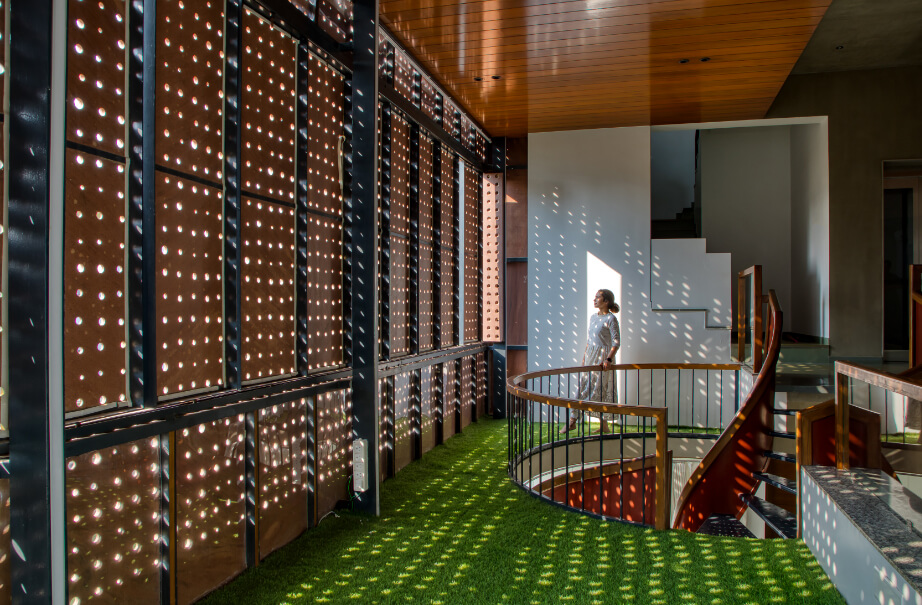
What truly sets the House of Breathing Stones apart is its use of stone, not as a surface but as a system. The stones are not treated as cladding or decorative finishes, but functional elements that shape thermal comfort, daylight quality, and spatial atmosphere.
The most striking example is the movable, perforated Dholpur red stone facade. These circularly perforated stone panels rotate, slide, and open, allowing residents to modulate privacy, ventilation, light, and views throughout the day. By engineering stone panels that move, the architects collapse the binary between heavy and light, solid and breathable, and inside and outside.
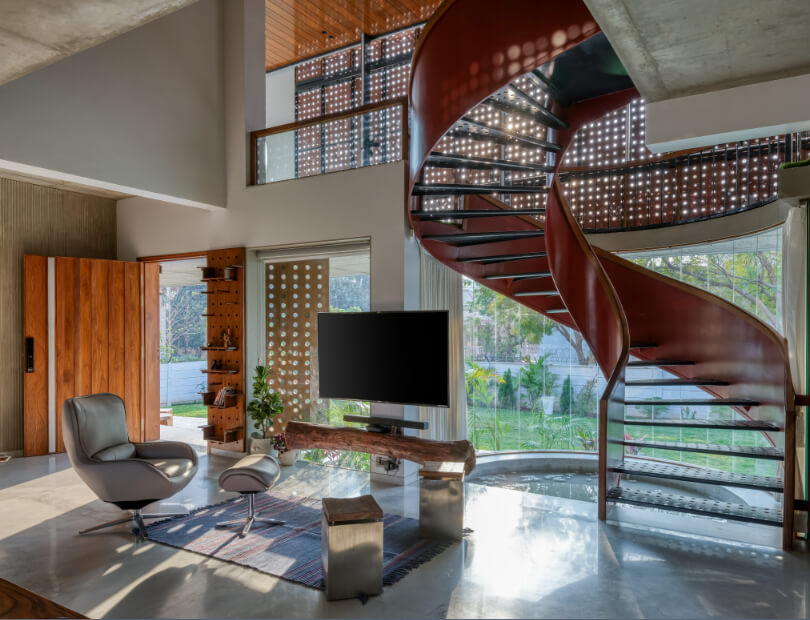
Paired with exposed concrete ceilings, natural wood, and white walls that act as a neutral canvas, the material palette allows stone to remain the protagonist, honest, expressive, and deeply contextual. Beyond the household, the project quietly supports the local stone artisans, proving that sustainability is also about sustaining craft and community.
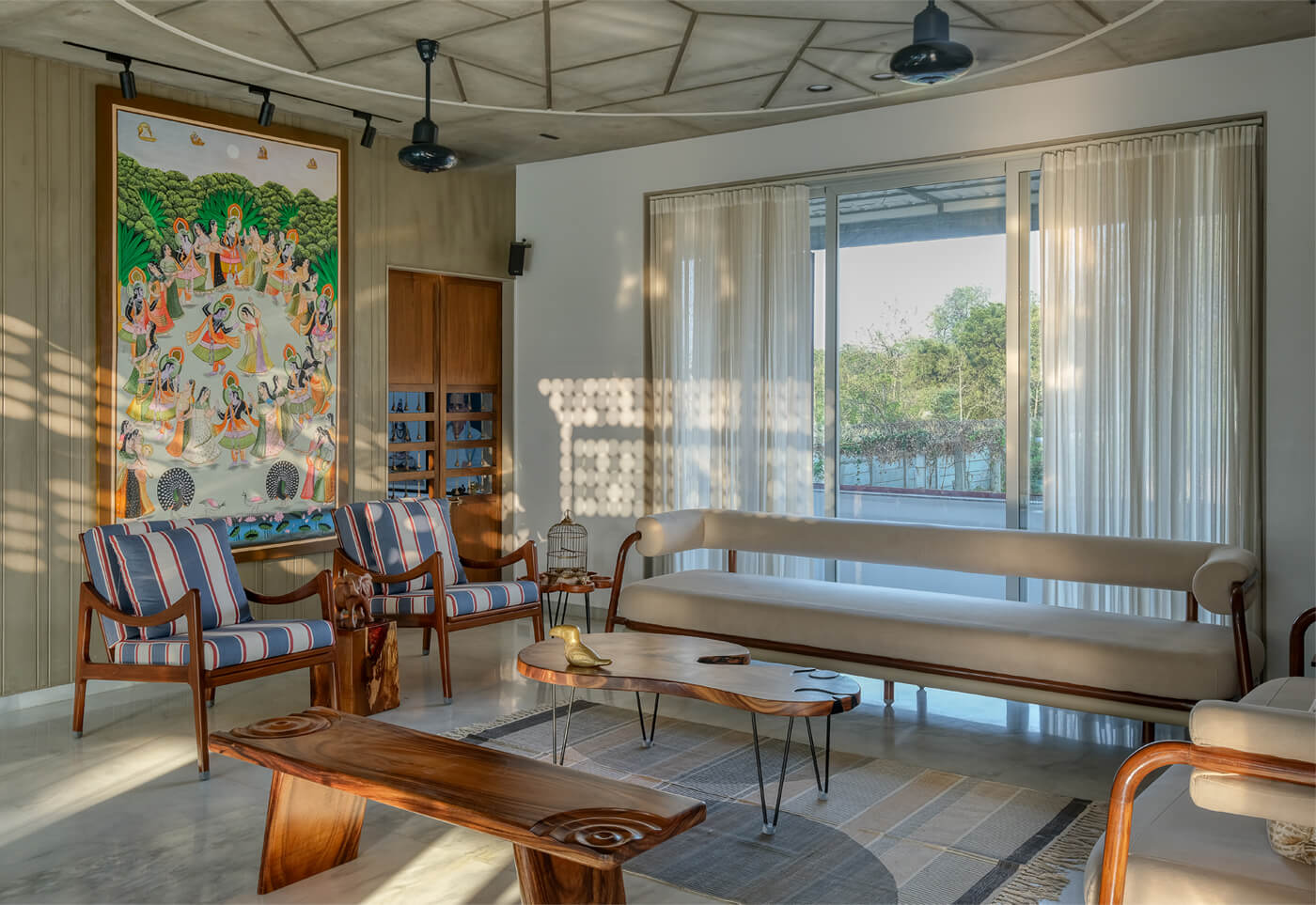
The house stands as evidence that working with stone demands patience, humility, and collaboration. It reminds us that the future of sustainable Indian architecture may not lie in novelty, but in reimagining the extraordinary potential of what has always been.
Read the complete article in Vol 3 Issue 1